Zero-Downtime Schema Migrations: Expand-Contract for PostgreSQL

A schema migration rarely looks scary when you first write it.
Add a column. Rename a field. Split some metadata into a cleaner table. Add an index so the new dashboard stops timing out. In a pull request, each of these can look like one tidy line of SQL.
Production sees something else — a table with millions of rows, old application code still running beside new code, background jobs writing during the deploy, dashboards reading every few seconds, and one migration trying to change the floor while everyone is still walking on it.
That is why zero-downtime migrations are not really a SQL problem. They are a coordination problem.
And coordination is exactly where most migration workflows are weakest. The plan lives in a Slack thread. The risk is explained in a comment. The rollout sequence is in someone's head. The schema diagram shows the destination, but not the journey.
That's the whole point of this article: not to turn you into a database lock encyclopedia, but to show how a team can make risky schema changes boring on purpose.
The real problem is invisible coupling
When a code deploy goes wrong, you usually have a clean escape hatch. Roll back the container. Disable the feature flag. Revert the commit.
Database changes are less forgiving. Once a column is dropped, old code cannot read it. Once data is rewritten, a rollback might require restoring from backup. Once a large table is locked, the application can fail even if the migration itself is technically "correct."
The trap is that the database is shared by more clients than your migration file admits:
- The current application version
- The next application version
- Background workers
- Reports and dashboards
- Customer exports
- Internal scripts
- Sometimes another service nobody remembered
So the dangerous question is not only, "Will this SQL run?"
The better questions are:
- "Can old and new code both survive this schema?"
- "Can this data move gradually instead of all at once?"
- "Can we verify the change before removing the old shape?"
- "Can someone reviewing the schema understand the plan without reading five migration files?"
That is the mental shift. A zero-downtime migration is not one perfect statement. It is a small story told in the right order.
A safe migration keeps the old world and the new world compatible long enough for the application, the data, and the team to catch up.
The pattern behind almost every safe migration
The pattern has a few names. Martin Fowler describes it as Parallel Change. Database teams often call it expand-contract.
For most product teams, three ideas carry most of the value:
- Expand the schema so it supports both the old behavior and the new behavior.
- Migrate the application and data gradually.
- Contract the old schema only after you have proof it is unused.
Expand
Adding a nullable column is usually quick. Backfilling millions of rows is not.
Creating a new table is usually safe. Moving historical JSON into it may take hours.
The rule is: make the schema capable first, then move data under control.
In TalkingSchema, this becomes a planning prompt:
"Split this change into schema-only steps and data-migration steps."
"What is the safest expand-contract plan for adding settlement_status to transactions?"
That one question catches a surprising number of bad migrations, because it forces the team to stop hiding a giant backfill inside a tidy migration file.
Migrate
Renames are the best example. A column rename looks harmless because it is fast. But the moment it lands, any old code still reading the old column name breaks.
The safer version is not a rename. It is a transition:
- Add the new column.
- Write to both columns.
- Backfill the new column from the old one.
- Move reads to the new column.
- Verify no code reads the old column.
- Drop the old column later.
That feels slower because it is slower. But it is slower in the way seatbelts are slower.
This is where visual review matters. In a text migration, a rename is one line. In a schema planning tool, it should be treated as a dependency change: old consumers, new consumers, dual-write window, verification, cleanup.
TalkingSchema gives you a shared place to ask:
"If I rename bank_account_number to masked_account_number, what breaks first?"
The answer should not only be SQL. It should include the application rollout story.
Contract
The contract phase is where teams get impatient.
The new column is live. The dashboard looks good. The old field feels like clutter. Someone wants to clean it up in the same pull request.
That is where the risk comes back.
The old path is your rollback story. Dropping it early saves a little schema neatness and costs you a lot of optionality.
Before the contract phase, you want boring evidence:
- Backfill progress is 100%.
- New reads are serving production traffic.
- No current code references the old column or table.
- Error rates did not move.
- You have waited through at least one normal deploy cycle.
TalkingSchema can help turn that into an explicit checklist instead of tribal memory:
"Create the verification checklist before dropping transactions.metadata."
The value is not that AI magically knows your production traffic. It does not. The value is that it forces the plan into a form your team can inspect, challenge, and improve.
Where tools fit
Migration tools are important, but they are not the strategy. They are the guardrails around a strategy you should already understand.
What each layer handles — and what it cannot decide for you:
- Flyway / Liquibase — version and run migration files. They do not decide whether your migration is safe.
- PostgreSQL —
CREATE INDEX CONCURRENTLY, fast defaults for non-volatile column defaults, andNOT VALIDconstraints can reduce blocking when used correctly. They do not tell you whether your app can tolerate the new schema. - gh-ost — valuable for large MySQL table changes; GitHub built it after hitting lock contention with older approaches. It can move a table carefully. It cannot tell your services when to stop reading the old shape.
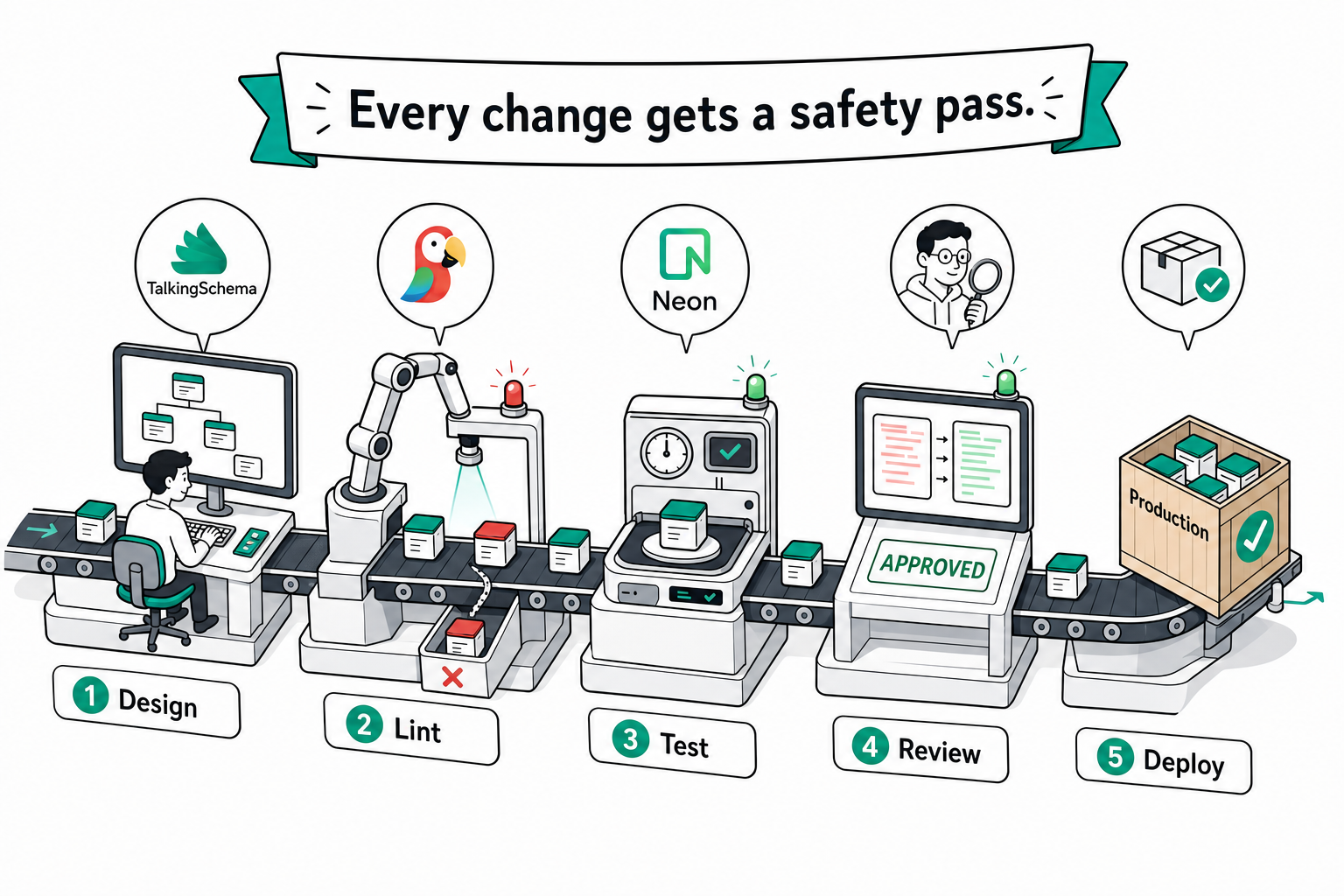
- squawk / pganalyze — catch obviously dangerous SQL before it lands: a blocking index build, an aggressive constraint, a migration that forgot a timeout. A good CI pipeline should run those checks, test against realistic data, and record what happened when it ran.
But notice where those tools enter the story: after someone has already written a migration.
That is late.
The better moment to catch risk is when the schema is changing for the first time. If a table is huge, if a rename needs compatibility, if a field removal is really a Phase 3 cleanup, that context belongs on the schema itself. Then every later step benefits from it.
TalkingSchema sits at the front of that workflow, where the expensive mistakes are still cheap to fix.
The quiet goal
The most dangerous migration is the one you convince yourself is safe enough to run without a plan.
Every production database that has ever paged an on-call engineer at 3 AM has a root cause that was visible in advance — the table was large, the operation needed exclusive locks, the application had no retry logic for connection timeouts. The information was always there.
Zero downtime isn’t about being clever. It’s about disciplined design practice.
If your diagram only shows the destination, you are asking production to infer the journey. Start with the schema you have today, describe the change in plain language, and ask what has to stay compatible while you move.
Plan your next migration in TalkingSchema →
Related Reference Documentation & Resources
To dive deeper into database schema design, checkout our curated resources and tool guides:
- ORM & Type Safety: Read How to Convert Schema to Code with Prisma, Drizzle, and TypeScript to solve the stale type problem forever.
- Compare Tools: Explore TalkingSchema vs DBeaver comparison to understand visual schema design versus query client operations.
- Compare Tools: Read the TalkingSchema vs MySQL Workbench comparison to see multi-framework schema modeling versus MySQL-centric administration.
- Dimensional Modeling: Learn how to design optimized star schemas with AI for advanced data warehousing.
- Product Workspace: Launch the interactive TalkingSchema Modeling Workspace to build, review, and export your database designs instantly.